
Continuing Education & CQR: What Every Radiologic Technologist Needs to Know
May 07, 2026
Earning your ARRT credentials is a milestone. Keeping them is the long game — and it requires understanding a layered system of annual, biennial, and decennial requirements that most programs don't fully prepare you for.
The day you pass your ARRT board exam is one of the proudest moments of your career in radiologic technology. But in the weeks and months that follow, the reality sets in: maintaining your certification and registration is an ongoing commitment — one that doesn't pause no matter how many years you've been practicing, how many hours you work, or how many credentials you hold. ARRT's maintenance system has three distinct layers, and understanding all of them is essential to keeping your hard-earned credentials intact.
In this post, I want to walk you through every component of that system — annual renewal, biennial continuing education, and the Continuing Qualifications Requirements — so you're never caught off guard by a deadline, a documentation requirement, or a rule you didn't know existed.
The three pillars of credential maintenance
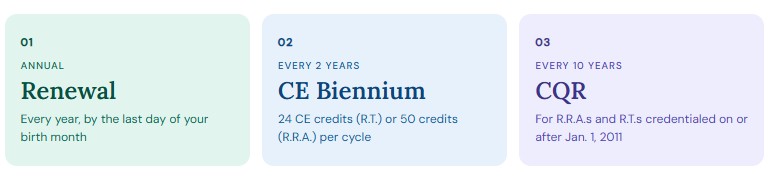
Once you earn ARRT certification and registration, you're responsible for three ongoing requirements. Each operates on a different timeline and has its own rules. Think of them as nested cycles — the shortest running every year, the middle one every two years, and the longest completing a full circuit every decade.
Across all three requirements, you must also remain continuously compliant with ARRT's Rules and Regulations and Standards of Ethics. Those aren't background noise — violations can end your certification entirely.
Annual renewal: the yearly checkpoint
Every single ARRT registrant — regardless of credential type, years of experience, or active practice status — must renew their certification and registration annually. Your renewal deadline is always the last day of your birth month, every year, without exception. The process is straightforward and can be completed online, but there's an important condition attached: to complete your annual renewal, your biennial CE requirements must be current.

One more thing about renewal deadlines: ARRT ties everything to your birth month. Your renewal deadline, your CE reporting deadline, and the structure of your biennium all orbit around that date. Get it on your calendar permanently — missing it has real consequences.
Biennial continuing education: the credit cycle that never stops
Continuing education became a mandatory requirement for ARRT renewal in 1995, and the rationale is straightforward: advancing technology and changing clinical responsibilities require that all imaging and radiation therapy professionals continuously update their knowledge and skills. CE requirements apply to all registrants — whether you work full-time, part-time, or not at all in clinical practice.
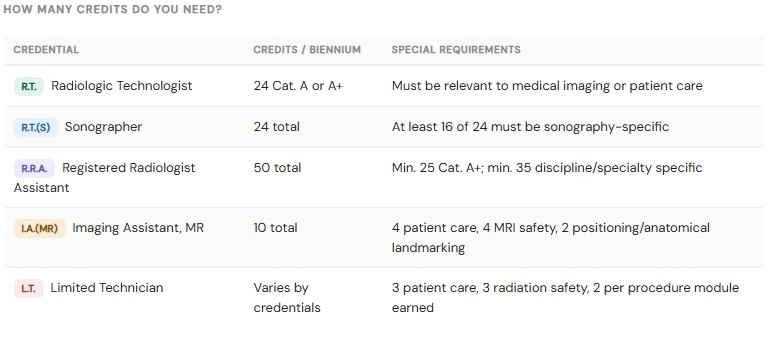 An important note for R.T.s holding multiple credentials: the 24-credit requirement doesn't multiply. If you're certified in both radiography and mammography, you still need just 24 credits per biennium for ARRT — though you'll want to be mindful of MQSA requirements separately, which ARRT does not govern.
What counts as a CE activity?
ARRT defines a CE activity as any learning activity that is planned, organized, and administered to maintain and enhance the professional knowledge and skills underlying professional performance. Eligible activities include approved online courses, self-study readings and modules, lectures at professional society meetings, and formally structured classroom learning. Academic courses from accredited institutions also qualify — at a rate of 12 CE credits per academic quarter credit or 16 CE credits per academic semester credit.
A few things that do not count toward ARRT CE requirements: activities approved only by the AMA, ANA, ANCC, or hospital accreditation bodies like The Joint Commission, as well as OSHA-required trainings like fire safety or patient restraints. Clinical instructorship and preparation of presentations also do not earn CE credit. And note that any single activity can only be used once within a given biennium — though it can be repeated across different biennia.

Understanding your biennium and its two deadlines
Your CE biennium is a two-year window defined in relation to your birth month. It begins on the first day of your next birth month after you earn your credential and runs for two years, ending the last day of the month before your birth month two years later.
Here is the part that trips up even experienced technologists: there are two different CE deadlines, and they are one month apart.

That one-month gap between completing CE and reporting it exists so you have time to gather documentation and submit your report accurately. It also means that if you're scrambling to finish credits in the final weeks of your biennium, you're already behind. Keep records of every activity you complete throughout your biennium — because ARRT only lets you report CE during the renewal period, not as you go. Credits earned in one biennium also cannot be carried forward into the next.
CE documentation: what you must keep
ARRT requires you to maintain proof of CE participation for five years. Your CE certificate must include specific elements — missing any of them can result in the credit being rejected during an audit: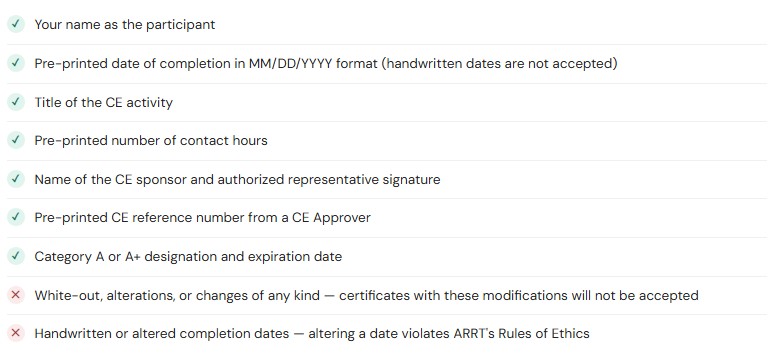
ARRT conducts random CE audits, and there is no limit to how many times you can be audited. If you're selected, you must provide documentation for every activity you reported. If you can't document compliance, your certification and registration will be discontinued.
What happens if you miss the CE deadline: CE probation
If you apply for annual renewal but haven't met your CE requirements, ARRT will assign you CE Probation status. This is not the end of your credential — but it's serious. The probation period runs six months from the first day of your birth month. During that window, you can complete the missing credits without additional penalty credits, then report them to ARRT along with a probation fee.
If you still haven't met compliance by the end of the probation period, your certification and registration will be discontinued. There is no limit to how many times you can be placed on CE probation, but each time requires additional credits to exit the status. And critically: CE probation status is reported publicly in response to any credential verification inquiry. Employers and state entities will see it.
Continuing Qualifications Requirements: the decade-long checkpoint
The CQR is the most comprehensive — and least understood — of ARRT's maintenance requirements. It applies to all R.R.A.s and to R.T.s who earned their credentials on or after January 1, 2011. If your credentials predate that cutoff and have never lapsed, you are not subject to CQR. But if your certification was revoked and reinstated on or after January 1, 2011, the CQR requirement follows you regardless of when you originally earned it.

How the 10-year period works
Your CQR 10-year period begins on the first day of your next birth month after you earn your credential. It ends on the last day of the month before your birth month, exactly ten years later. Once established, that anchor date never changes — even if you discontinue and later reinstate your credential. If you hold multiple credentials subject to CQR, each credential has its own separate 10-year period.
The three-year window at the end of that 10-year period — beginning on the first day of your birth month in year eight — is called the CQR Compliance Period. That is when you must actually complete the CQR process.

The CQR process begins with a Professional Profile — a brief online survey asking you to indicate how often you've performed various clinical activities during the last two years. The profile is grounded in ARRT's practice analysis data, so it reflects what entry-level professionals in your discipline are actually doing. The profile summary shows you a graphical representation of your responses relative to other practitioners in the same discipline, and it may include optional Clinical Refreshers — short educational activities about specific procedures. Completing the refreshers is voluntary and they are not CE activities, but they're worth your time.
The Structured Self-Assessment (SSA)
The SSA is the heart of CQR. It's a proctored assessment designed to help you identify gaps in the knowledge underlying practice in your discipline. Results are reported as "standards met" — there is no pass or fail in a traditional sense. Where the standard is not met, the results report specifies the number of CE credits you'll need to complete to satisfy CQR for that content area.
If you'd prefer not to take the SSA, you may elect to self-select a full CE prescription in lieu of the assessment. The CE completed for CQR must be completed after the prescribed CE is assigned and within your compliance period. The SSA itself is provided at no cost under normal circumstances, but rescheduling or missing your appointment will trigger a fee from ARRT's administration vendor.
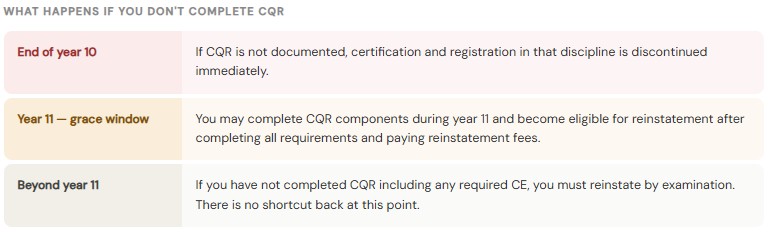
One more critical note: if you lose a credential that supports another credential because of CQR non-compliance, the supported credential is also discontinued at the end of year 10. The cascade effect is real.
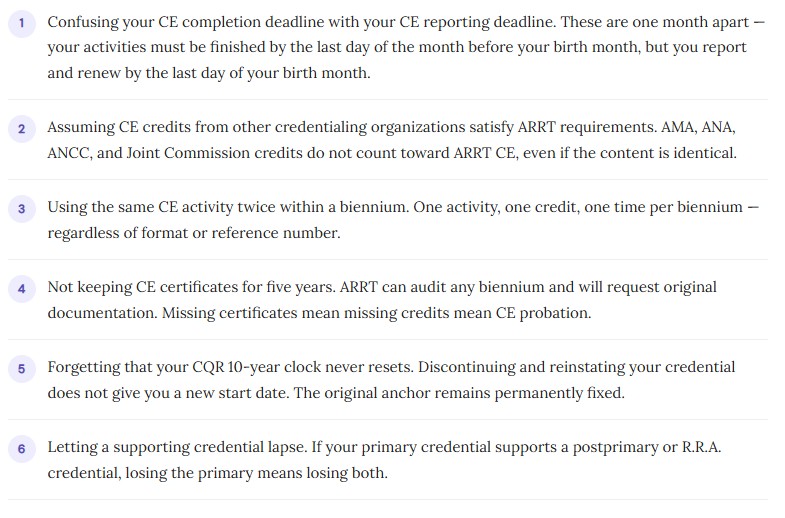
Common pitfalls — and how to avoid them
 A final word
When patients come to us, they trust that the person operating the equipment holding their diagnosis is qualified — not just on the day they passed the boards years ago, but today. ARRT's maintenance system exists to ensure that trust is warranted. Annual renewal keeps the administrative record current. Biennial CE ensures you're continuously engaging with the evolving knowledge base of the profession. And CQR holds all of us accountable to the standard that entry-level practitioners are being trained to meet right now.
These requirements aren't bureaucratic hurdles. They are the infrastructure of professional accountability in a field where the margin for error is measured in patient outcomes. Know your deadlines. Document everything. Don't wait until the final year of your compliance period to start thinking about CQR. Your credentials — and your patients — are worth that diligence.
Information in this post is based on ARRT's published continuing education FAQ, the ARRT Education Requirements for Obtaining and Maintaining Certification and Registration (last revised March 31, 2026), and ARRT's official online guidance for registrants. Requirements are subject to change — always verify deadlines and credit requirements in your ARRT online account dashboard and the current edition of the governing documents at arrt.org.
To get your CE credits done, go to https://www.radtechregistry.com/buy-1-asrt-course-get-3-free
Stay connected with news and updates!
Join our mailing list to receive the latest tips, tricks and insights to help you pass your registry!
We hate SPAM. We will never sell your information, for any reason.