Everything You Need to Know Before Sitting for Your ARRT® Exam
May 06, 2026
A practical guide to scheduling, exam day procedures, and what happens when things don't go according to plan — from someone who has been there.
Sitting for your ARRT certification exam is one of the most significant milestones of your career in radiologic technology. After years of coursework, clinical rotations, and relentless preparation, the last thing you want is to lose your exam window over a preventable administrative mistake. I want to walk you through everything — from the moment you receive your Candidate Status Report to the day you log into your ARRT account and see your official results.
Start with the content outline, not a prep book
Before anything else, get your hands on ARRT's official Content Specifications — sometimes called content outlines — for your discipline. These documents map out every topic area your exam will cover. While ARRT doesn't endorse any specific study materials, virtually every program director I know recommends these outlines as the cornerstone of your prep strategy. Relevant professional societies can also point you toward additional study resources if you want more structured guidance.
Your Candidate Status Report: read it like a contract
Once ARRT processes your application, you'll receive a Candidate Status Report. Primary pathway applicants get this by mail; postprimary pathway applicants can find it in the postprimary tool within their online account. Do not treat this document casually. Check every single detail for accuracy before you do anything else.

If there's a discrepancy in your name, call ARRT immediately at 651.687.0048. State licensing candidates should contact their state entity directly — you'll find that number on the Report itself. Don't wait to resolve this. A mismatch on exam day means you'll be turned away, forfeit your fee, and have to start the application process over.
Scheduling and the cancellation rule
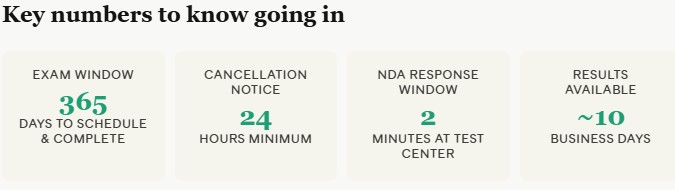
For ARRT certification and registration, you have 365 days from the date your application is processed to schedule and complete your exam. Once you book your appointment, treat that date seriously. If you need to reschedule, you must cancel at least 24 hours — one full business day — before your appointment time. If you have a Monday appointment, make sure you cancel no later than that same time on the preceding Friday.

What to bring — and what to leave home
You need two forms of acceptable identification. The first must be a valid, government-issued photo ID with your signature. The second must be current and must show your printed name and signature. A quick note on military IDs: some have a barcode where the signature should be, and the test center cannot accept those. Make sure your signature is physically on the card.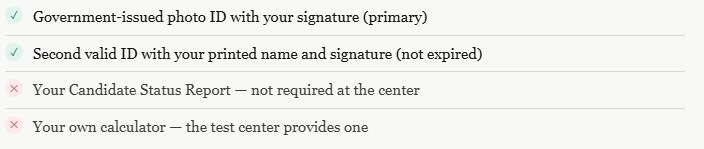
Inside the test center: the NDA and your exam clock
After a brief computer-based tutorial, you'll be presented with a Nondisclosure Agreement on screen. Read it carefully: you are prohibited from disclosing, reproducing, or transmitting any portion of the exam in any form. You'll have two minutes to accept. If that timer expires — or if you decline — the exam ends immediately, permanently. You cannot restart. You forfeit your fee and must reapply. Fortunately, this specific circumstance doesn't count as one of your three attempts within the three-year window, but you still lose the money and the appointment.
One thing that surprises many first-time candidates: breaks are not built into the exam appointment. The clock runs continuously through your tutorial, the exam itself, and the optional satisfaction survey at the end. You can step out, but time keeps moving. Take care of everything — a snack, a restroom visit, whatever you need — before you check in. If the testing environment is noisy, ask the staff for noise-reduction headphones or earplugs. Ambient noise is not grounds for an administrative appeal, but those accommodations are available if you request them.
Your score: preliminary vs. final
At the conclusion of your exam, you'll receive a preliminary score. I want to be very clear about this: that number is not your official result and does not confirm whether you've passed. Your official results will be posted in your ARRT account within approximately 10 business days. You'll receive an email notification — check your spam folder — and a copy will also appear in your Message Center. ARRT does not give scores over the phone, so don't call hoping for an early answer.
Scoring errors are extremely rare given ARRT's quality-control procedures. However, if you genuinely believe a calculation error occurred, you may submit a scoring appeal for a fee within a specific timeframe. Your candidate handbook will have the exact instructions and deadlines.
A final word on preparation
The clinical and didactic preparation you've completed is the foundation. But exam day is also a logistical event, and logistics can derail even the most knowledgeable candidate. Confirm your appointment details. Verify your ID situation weeks in advance. Know your test center address and give yourself more travel time than you think you need. Arriving confident and prepared — not frazzled by an avoidable last-minute issue — gives you the best possible chance to demonstrate everything you've worked for.
Good luck. You've earned the right to be in that testing room.
Stay connected with news and updates!
Join our mailing list to receive the latest tips, tricks and insights to help you pass your registry!
We hate SPAM. We will never sell your information, for any reason.