Understanding ARRT®'s Ethical Requirements: What Every Rad Tech Needs to Know
May 12, 2026
Your ARRT credential isn't just proof of clinical competency — it's a public statement that you are qualified, trustworthy, and committed to ethical practice. Here's what the ethics requirements actually mean, and what they require of you.

When most people think about what it means to be a qualified radiologic technologist, they think about board scores, clinical competencies, and continuing education. Those things matter enormously. But ARRT places equal weight on something less visible: your ethical conduct. The ethics requirements aren't a formality that you checked off when you passed your boards. They are an ongoing, enforceable set of standards that follow your credential for as long as you hold it.
In this post I want to walk through the full scope of ARRT's ethics framework — what it consists of, what it requires of you day to day, how violations are handled, and what the consequences can look like. Understanding this system isn't just useful for staying out of trouble. It's part of what it means to be a professional.
The ARRT Standards of Ethics: two distinct documents in one
ARRT's ethics framework is governed by the Standards of Ethics, which is made up of two separate parts that serve very different purposes. It's important to understand the distinction between them.
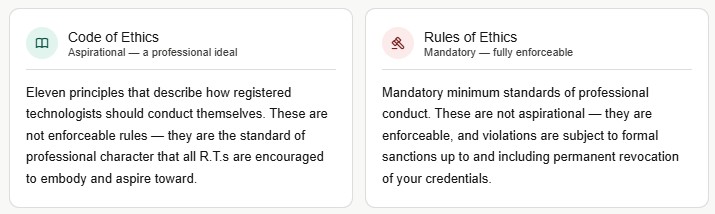
The Code sets the ceiling of what a great professional looks like. The Rules set the floor of what is minimally acceptable. Falling below the Rules doesn't just reflect poorly on you — it makes you subject to investigation, hearing, and sanction by ARRT's Ethics Committee.
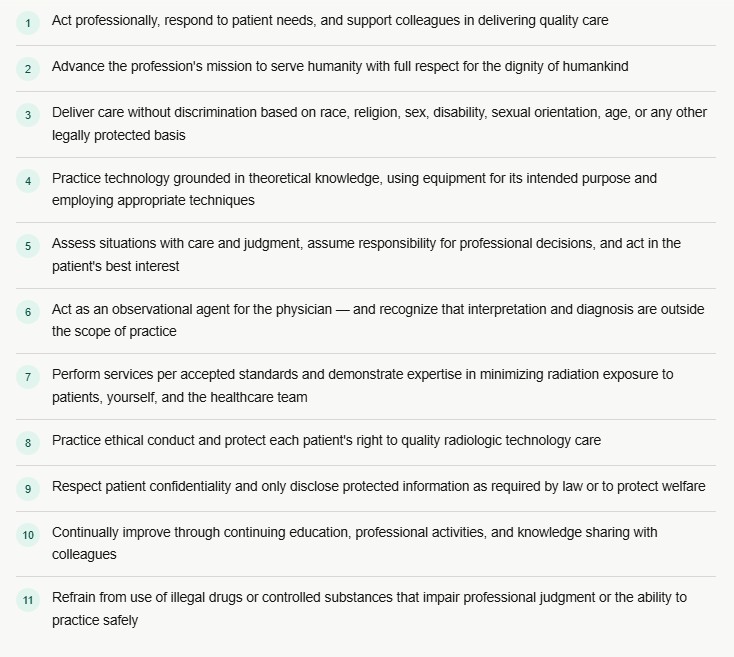
The Code of Ethics: 11 principles to live by
The Code of Ethics consists of eleven principles that collectively define the professional character ARRT expects of every registered technologist and candidate. Because they are aspirational, they can't be enforced directly — but they describe the standard of conduct that separates a credentialed professional from someone who merely holds a credential.
The Rules of Ethics: mandatory standards
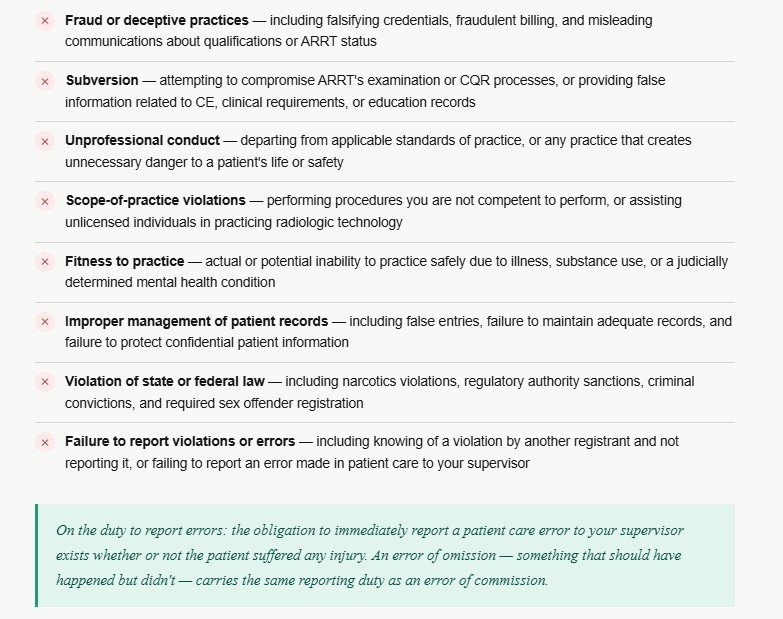
Where the Code describes the ideal, the Rules define the minimum. ARRT organizes the Rules of Ethics into eight categories of prohibited conduct. Engaging in any of these — or permitting them to occur — constitutes a violation and makes you subject to formal sanctions.
Reporting ethics violations: the 30-day rule
One of the most important — and most commonly misunderstood — aspects of the ethics requirements is the reporting obligation. As a registrant, you are required to report potential ethics violations to ARRT within 30 days of the occurrence. This includes state licensing issues, criminal charges, and criminal convictions. Whichever comes first — the 30-day window, your annual renewal, or an application for an additional credential — that is your reporting deadline.

A few clarifications on reporting that trip people up:
You only need to report a violation once — but if you reported a charge and are later convicted, the conviction must also be reported. Reporting to your state licensing board does not satisfy your obligation to ARRT. Both entities are separate, and both require notification. If court records are unavailable, a notarized statement describing the charge, sentence, and court conditions will be accepted.

That last number is worth emphasizing. The vast majority of ethics cases do not result in revocation. Reporting a violation is not the same as losing your credential — but hiding one can be.
How the ethics review process works
When a potential violation is brought to ARRT's attention — whether through self-report, a third-party report, or ARRT's own processes — the Ethics Committee reviews it. In most cases, registrants maintain their certification and registration throughout the review. The process can take three months or more, and your cooperation is directly tied to how efficiently it moves. Responding promptly to correspondence and document requests is both a practical strategy and a requirement.
The Ethics Committee is composed of five ARRT trustees appointed by the president. After reviewing the evidence, the committee determines whether a violation occurred and, if so, what sanction is appropriate. Registrants have the right to a formal hearing — with at least 30 days' notice, the ability to present testimony, call witnesses, and cross-examine opposing witnesses. Decisions can be appealed to the Board of Trustees within 30 days.
Sanctions: the range of possible outcomes
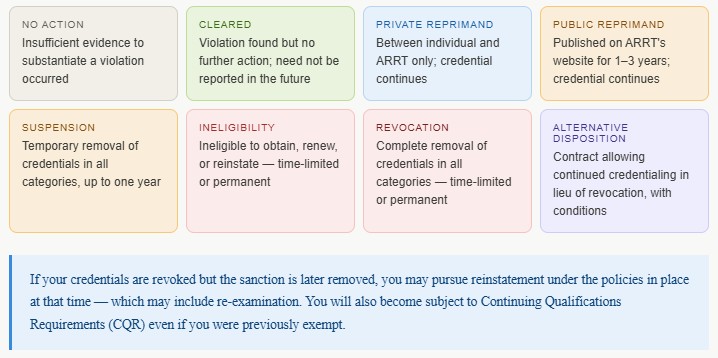
Not all ethics violations are treated equally, and ARRT has a broad range of actions available depending on the nature and severity of the conduct. Each case is evaluated individually.
Practical takeaways for every registered technologist
Most R.T.s will never face an ethics investigation. But the requirements apply to all of us, at all times, regardless of how long we've been practicing. A few habits that keep you in good standing:
Review the ARRT Standards of Ethics document annually — ARRT recommends this explicitly, and it only takes a few minutes. Keep your knowledge of the scope-of-practice rules current, particularly around procedures you're not trained to perform independently. Document patient care accurately and completely. If you become aware of a violation by a colleague, understand that you have a reporting obligation, not just a choice. And if something happens in your own life — a charge, a conviction, a licensing issue — report it to ARRT within 30 days, before your next renewal, and before you apply for any additional credentials. Do not wait to see how it resolves.
The ethics requirements exist because patients and the public deserve to trust that the people imaging them are not just technically qualified, but genuinely trustworthy. That's not a burden. It's the foundation of the profession.
Stay connected with news and updates!
Join our mailing list to receive the latest tips, tricks and insights to help you pass your registry!
We hate SPAM. We will never sell your information, for any reason.